
2020-12-01
The Trust and Reputation Network Initiative
When John Donne, the English poet and cleric, proclaimed that ‘no man is an island’, he also reflected the Ubuntu principle of ‘I am what I am because of who we all are’. The collective and contingent nature of life in 16th century England is analogous to the present day experience of the financially/socially marginalized majority populations in emerging economies, such as those of Sub Saharan Africa (SSA).
In developed world societies these collectives have come to be represented by larger political realities and financial structures that effectively negate the prior requirement for local, personal support networks. While no man is an island, the primacy of the individual has become an accepted premise. This is reflected in the individualized nature of developed world financial services and products, a trend that is both accelerating and provoking alternatives
In emerging economies there has been a well-documented ‘financial revolution’ whereby previously unavailable services such as electronic funds transfer, savings and credit have been realized through digitization, and made available through mobile telephony technologies. This ‘new market’ represents an opportunity to engage both the developed and emerging economies in ways that provide benefit to both: financial inclusion for the excluded through market penetration of established developed world financial service providers. SSA is perhaps both the greatest challenge and greatest opportunity for the developed world financial services sector.
However, repeated attempts to bind these markets have failed, particularly in the provision of products as insurance. These failures represent the doomed attempt to apply the developed world individualized concept on the marginalized portions of emerging societies that largely operate at the level of the collective.
While SSA has widely adopted and ever increasing participation in mobile money services, most participants have never written a cheque, never owned a credit card – and likely never will. The financial behaviour evident in the individual digital exhaust of developed world markets does not exist – and may never exist. Therefore, the processes and approaches employed within the developed world financial sector cannot work – and may never work.
These emerging economies represent a fundamentally different market: one of low value but very high volume of transactions that require highly scalable and low-to-zero variable processing costs. But at least as important is an understanding of how these societies operate and work within the current modes and traditions of exchange.
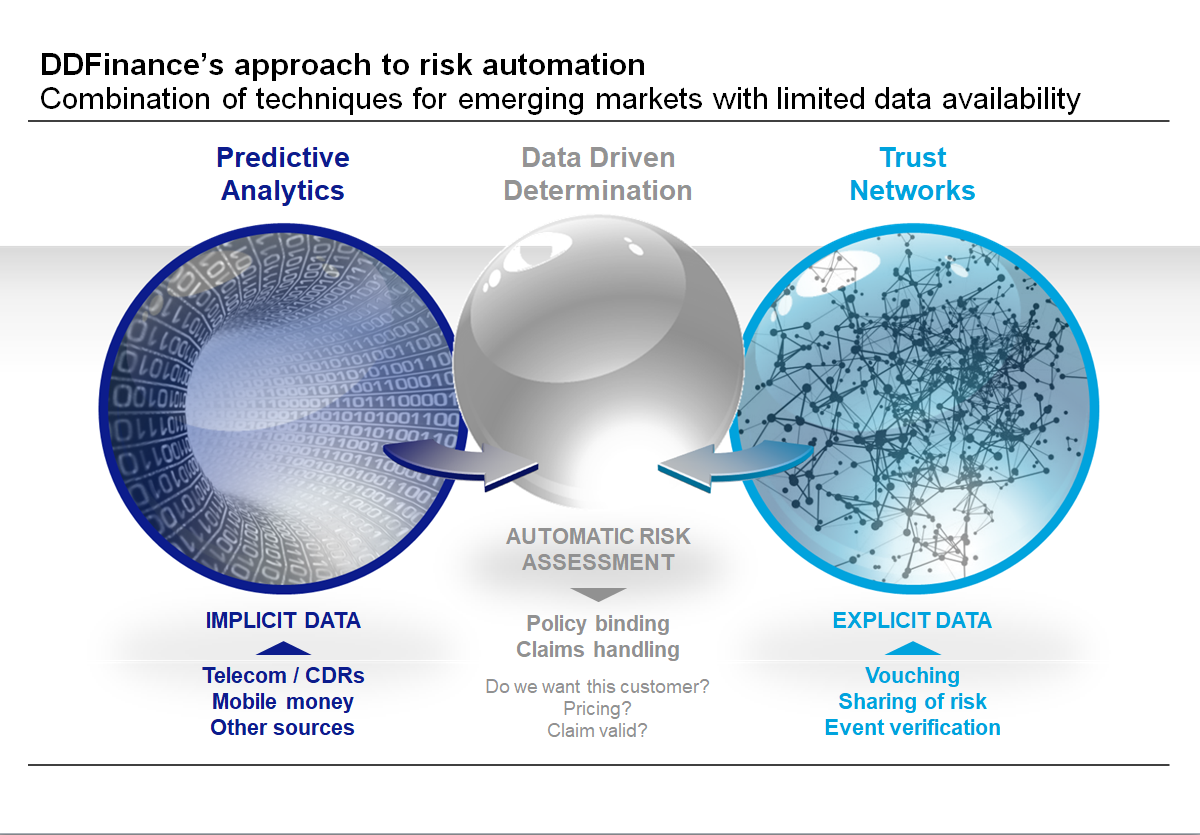
Repeated attempts to leverage techniques such as predictive analytics to achieve automation and scalability have failed. And they will continue to fail because they address a market that does not exist in SSA - the developed world, information rich marketplace with deep, wide, high quality individualized data.
Further, these services view the marketplace as a collection of individuals, rather than as collectives consisting of individuals, who are bound by informal networks of trust and reputation.